
November 23, 2026
Pipeline enrichment: fewer AI SOC tokens, fewer analyst pivots, fewer playbook calls


Darwin Salazar
Head of Growth
Traditionally, enrichment has happened after the alert, and for good reason. The SIEM is where detections run. Teams centralize some context there, such as EDR alerts, threat intel feeds and asset inventories. Other context usually stays where it originates: employment status and manager in the HR system, admin roles in each SaaS app, device compliance in MDM. So when a rule fires, triage goes and gets what's missing.
Who does that triage is changing. SOAR playbooks took over the routine lookups years ago. Now AI triage and response agents increasingly handle first intake, calling the same APIs on every alert and spending tokens on each one.
Meanwhile, attacks have sped up. Microsoft's ARTEX report describes an AI agent that went from searching GitHub for secrets to stealing Azure Key Vault data in five minutes. SoftBank Corp.'s CEO said a ransomware attack on its cloud subsidiary took seven. A process that starts after the alert is already behind.
At Monad, we feel strongly that the first cut at enrichment belongs in the pipeline. There is useful context that belongs in critical log source events, and baking that in deterministically vs. waiting until after an alert fires is playing the game backwards.
In the pipeline, the lookup is a read from a table the pipeline keeps current. After the alert, it is an API call that the analyst, the playbook or the agent repeats for every alert. Do it once in the pipeline, and every alert arrives with the answer on it.
That is pipeline enrichment. While a log is in the pipeline, a lookup matches a field such as the user's email or source IP. It writes what it finds onto the event. With Monad, you can enrich from any of 350+ sources, one of the broadest enrichment ecosystems on the market. For example, an OpenAI audit log event can pick up the user's Okta status and department before it reaches the SIEM.
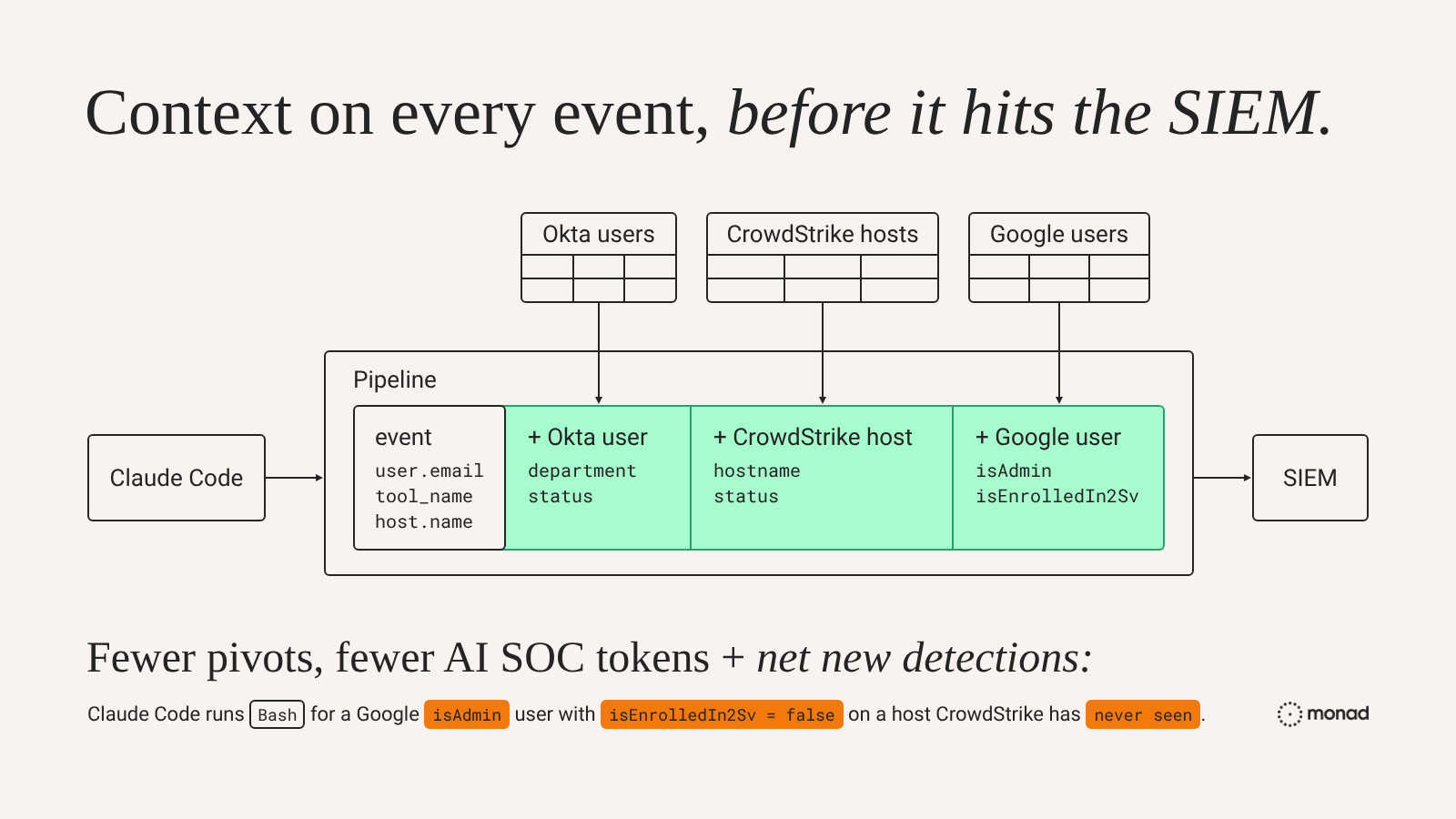
Below: that event before and after, what it saves, how it works, and three detections that need no joins.
What it looks like
Here is an OpenAI audit log event before and after a lookup against your Okta users.
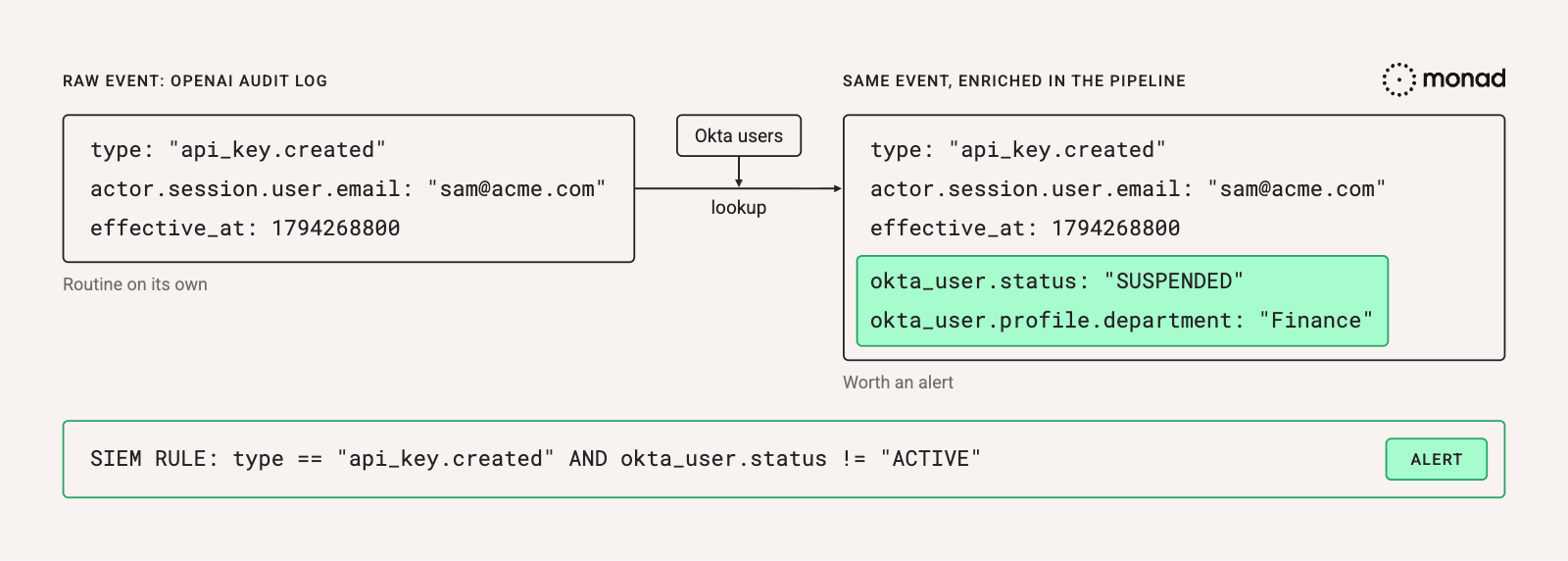
The raw event says someone created an API key. The enriched event says a suspended finance user did. Only the second one is worth an alert.
Monad does not run the detection. Your SIEM does, and it gets a better event to work with.
Why enrich before the SIEM
- Analysts stop pivoting across tools. The Okta status and the IP reputation are already on the alert. We have put that hunt at 15 to 30 minutes per alert.
- SOAR playbooks get smaller. Most playbooks are enrichment playbooks: call Okta, call threat intel, attach the results. Do those lookups in the pipeline and the playbook can go straight to the response.
- AI SOC agents cost less and make fewer mistakes. An agent that fetches its own context has to pick the lookup, call the tool and read the result. Each step costs tokens and can go wrong. A pipeline lookup is deterministic, so it runs the same way every time and never skips a step.
- Detections get sharper. A rule can only check fields that are on the event. "API key created" is routine. "API key created by a suspended user" should never happen, so when it fires, it is real.
- You get the state from event time. A lookup at triage returns today's state. By then the account may be re-enabled or the role removed.
- Enrich once, use it everywhere. The same enriched event can go to your SIEM and your data lake. You can also route on the new fields and keep low-value logs out of the SIEM.
How it works
- A feeder pipeline loads a lookup table. Example: your Okta users, keyed on email and refreshed every hour.
- Your log pipeline looks up each event's user in that table.
- The match is written onto the event, and the event goes on to the SIEM.
You pick the table, the field to match on and where the result goes. You can preview the enriched event before you turn it on.
Detections you can write
Each rule checks two things on one event: a field from the log and a field the pipeline added. These are pseudocode, with no joins and no lookups at query time.
# OpenAI API key created by a user who is not active in Okta
type == "api_key.created"                             # OpenAI audit log
AND okta_user.status != "ACTIVE"                      # added from Okta

# Claude Code shell command from a user outside engineering
event.name == "tool_result" AND tool_name == "Bash"   # Claude Code
AND okta_user.profile.department != "Engineering"     # added from Okta

# OpenAI login from an IP GreyNoise classifies as malicious
type == "login.succeeded"                             # OpenAI audit log
AND greynoise.classification == "malicious"           # added from GreyNoise
The rule fires on the first bad event, and the evidence is already in the alert. You can also run more than one lookup on the same event, such as the Okta user and then the source IP.
What to watch for
- The context is only as fresh as the lookup table. Monitor the feeder pipeline like any other detection dependency.
- Okta's list-users API leaves out deprovisioned users. A fully offboarded user will have no match, so make the rule fire on no match too.
- The lookup runs when the event passes through the pipeline. For late or backfilled logs, that is not when the event happened.
- Added fields add bytes. Add the ones your rules use.
Learn more
See how pipeline enrichments work. For more on ARTEX, read the briefing in The Cybersecurity Pulse.
Related content
Darwin Salazar
|
November 23, 2026

Kenneth Kaye
|
November 10, 2026
Valerie Worman
|
November 3, 2026