.png)
June 4, 2026
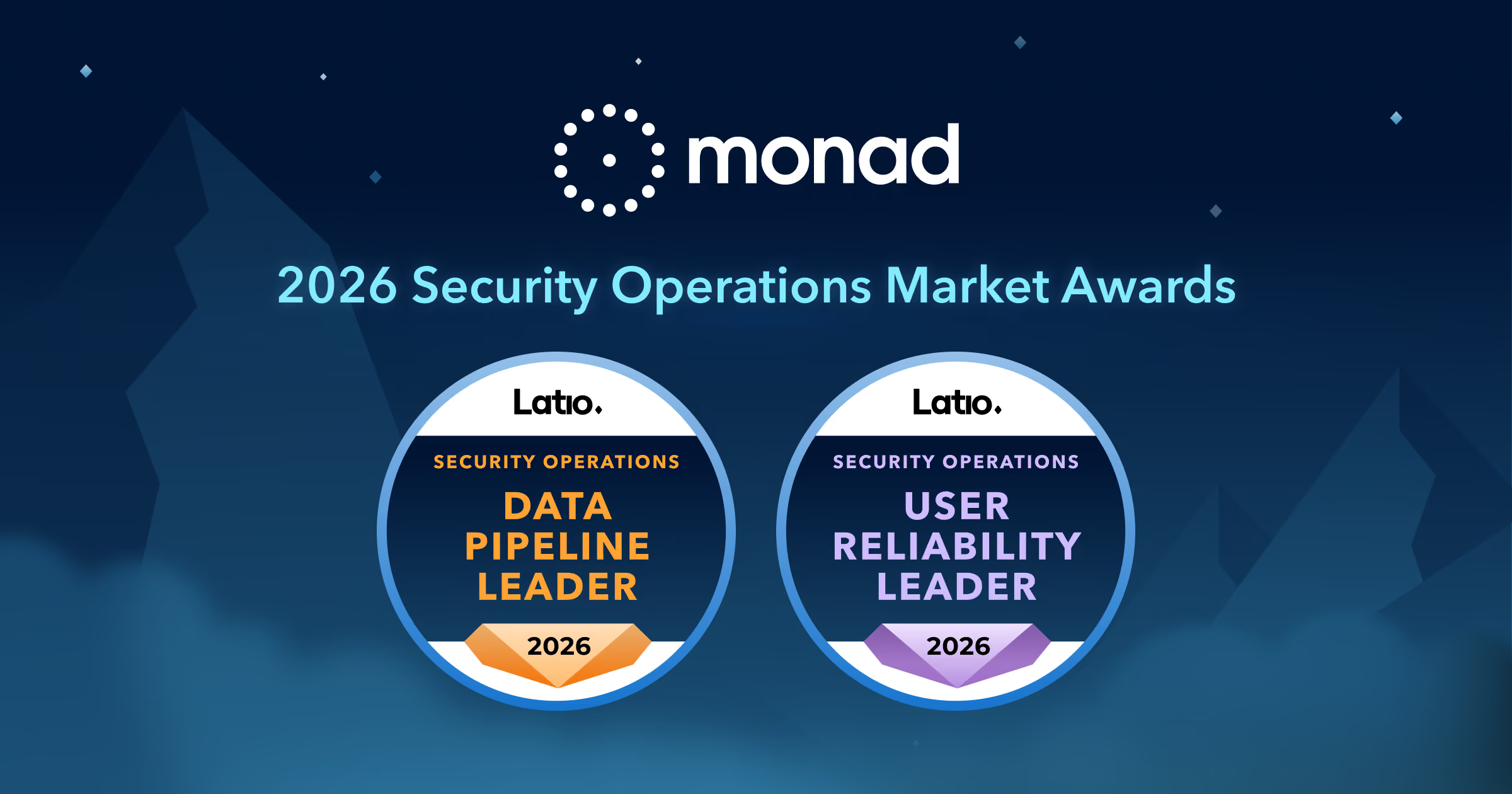
Monad Named a Data Pipeline Leader and User Reliability Leader in Latio's 2026 Security Operations Market Report

Valerie Worman
Head of Marketing
Monad is a Leader in Latio's 2026 SecOps Report
Security teams are being asked to migrate SIEMs, reduce ingestion costs, enrich more data before detection, and avoid getting trapped in a single vendor's ecosystem. That only works if the routing layer stays independent, reliable, and powerful enough to handle production security data at scale.
That's why Monad's recognition in Latio's 2026 Security Operations Market Report matters. Monad was named both a Data Pipeline Leader and a User Reliability Leader, two recognitions that reflect two distinct things we care deeply about.
The Data Pipeline Leader recognition is about more than vendor neutrality. Latio selected leaders in this category based on their ability to function as a standalone solution and route data without committing to a single backend. Monad does that, but it also gives teams a superior pipeline layer through robust transformations, in-flight enrichment, rule-based data routing, and 300+ integrations across security, IT, cloud, identity, and data platforms.
The User Reliability Leader recognition is about something just as important: the product works, teams can see what is happening, and they can depend on the pipeline when sensitive security logs are on the line. Monad gives teams granular visibility into pipeline health and performance, with alerting that can page the right people when something breaks or data stops flowing. For a category where silent failures and maintenance overhead are the norm, that's not a nice-to-have. It's core infrastructure.
What Latio's 2026 SecOps Report found
The data pipeline category has a vendor commitment problem. Most pipeline tools weren't built with vendor neutrality in mind, and the ones that were have since been acquired into larger platforms that have every incentive to route data toward their own ecosystem. For teams planning a SIEM migration, trying to avoid vendor lock-in, or managing data across more than one destination, that's a meaningful constraint.
James Berthoty's data pipeline section identifies three trends shaping the category right now:
- SIEM vendors are building their own first-party pipeline tools, which means the routing layer is increasingly where vendors enforce dependency and switching costs get built in.
- Some providers are running detections at log ingest rather than through retroactive searches, which changes the calculus on what a pipeline tool needs to be.
- Pipeline tools have become central to SIEM migration strategy. If you can route data independently, you can move between back-end providers without rebuilding everything from scratch.
The observation that stood out most was about vendor commitment. Many practitioners Berthoty interviewed "were frustrated with larger platforms expanding into broader data use cases and no longer prioritizing security use cases." That's a real tension, and a familiar one. When a platform's pipeline tooling exists primarily to pull data into its own ecosystem, vendor lock-in is the point, not a side effect. The incentive to help you route elsewhere simply doesn't exist. Vendor-neutral routing, as the report notes, is often "an afterthought, or as a result of an acquisition." And even when neutrality is acquired rather than built, it rarely survives the roadmap.
Why the recognitions matter
The design is deliberately not tied to a single destination. You can route to Splunk, Microsoft Sentinel, a data lake, long-term storage, or multiple destinations simultaneously. If your SIEM changes, the pipeline doesn't have to. During a migration, that means teams can dual-route data, validate coverage in the new backend, and cut over without rebuilding every collection path from scratch.
Reliability matters because security logs are not ordinary application telemetry. If an authentication source, endpoint tool, cloud service, or detection-critical data stream stops flowing, the security team needs to know quickly. Monad gives teams visibility into pipeline health and performance, alerting when something goes down or behaves unexpectedly, and backfill capabilities that help recover data after an interruption instead of leaving permanent gaps.
Monad does this reliably, at scale, and without requiring significant engineering attention to maintain. Customers including Robinhood, CoreWeave, and large-scale security vendors like Saviynt use Monad in production environments where pipeline reliability, support responsiveness, and scale matter. That's what User Reliability means in practice, and it's what we've built toward deliberately.
A note on fit
Neither recognition means Monad is the right fit for every team. If your SIEM vendor's native pipeline tooling covers your collection and routing needs, that may be enough. But if any of the following are true, it's worth a serious look:
- You're managing data across multiple sources and destinations and need routing that isn't tied to a single backend
- You're running into cost problems driven by what's getting ingested, and need to optimize what goes where and at what storage tier
- You need enrichment to happen before data lands in the SIEM rather than after, pulling in user context, geolocation, asset inventory, or threat intel in-flight
- You're dealing with silent log failures or inconsistent field ingestion that creates detection blind spots over time
- You need logs normalized to a consistent schema like OCSF across sources that all represent the same concepts differently
Monad is purpose-built to be security data pipeline infrastructure, and that's it. We're not trying to be your SIEM, your data lake, or your analytics platform. We collect logs from 300+ sources, enrich events in-flight with threat intel, GeoIP, asset inventory, and identity context before they hit any destination, filter out the noise that drives your ingestion bill without adding detection value, and route clean, contextualized data wherever it needs to go. If that's one destination, great. If it's four, also great.
The vendor neutrality isn't a feature we added. It's the reason Monad exists. Your pipeline shouldn't have an opinion about where your data lives.
Get the report
The full 2026 Latio Security Operations Market Report is available here. If you want to see how Monad handles your specific data routing or enrichment needs, you can schedule a demo or start a 14-day free trial.
Related content
Valerie Worman
|
September 23, 2026
.avif)