.png)
May 26, 2026
What Is a Security Data Pipeline Platform (and Why It's Becoming Critical Infrastructure for Security Teams)

Christian Almenar
Co-founder & CEO

Matt Jane
Chief Architect & CTO
The term keeps showing up, but what does it actually mean?
If you've been paying attention to how security operations teams talk about their data problems over the last two years, you've probably noticed a phrase gaining traction: security data pipeline platform, sometimes shortened to SDPP. Forrester analysts have written about data pipeline management for security. Gartner's peer community has polled IT leaders on what types of pipelines their organizations are running. CrowdStrike acquired Onum. SentinelOne acquired Observo AI. Palo Alto Networks acquired Chronosphere for $3.3 billion.
The category is real, and it's consolidating fast. But the marketing around it has already started to blur what these platforms actually do, who they're for, and why security teams specifically need something purpose-built rather than borrowing from general-purpose data infrastructure.
This post is an attempt to define the term clearly, explain the problems that created the category, describe the core capabilities that matter, and give security teams a practical framework for evaluating these platforms.
The problem that created the category
Security teams generate and consume enormous volumes of data. A large enterprise might run 75 or more security tools across endpoint, cloud, identity, network, and SaaS layers, each producing logs, alerts, findings, and telemetry. That data needs to get somewhere useful, usually a SIEM, a data lake, or both, in a format that analysts and detection engineers can actually work with.
For most of the last decade, there were two ways to make that happen.
Option one: let the SIEM handle it. Your SIEM vendor provides native integrations, ingests everything, and charges you per GB. This works until the bill arrives. SIEM vendors price on ingest volume, and they have no financial incentive to help you send less data. Indexed data in a SIEM can balloon to three to five times the raw log size. The result is budgets that double at renewal, with security leaders spending more time negotiating licenses than improving detection coverage. And because all your data, parsers, detection rules, and historical context live inside one vendor's platform, switching becomes prohibitively expensive. The lock-in is architectural, not just contractual. Forrester's Allie Mellen has noted that reducing SIEM ingest costs is one of the most common questions she gets from clients.
Option two: build it yourself. Your security engineering team stands up Kafka, writes Python scripts, builds custom parsers for each source, and maintains the whole thing. This approach offers total control. It also quietly turns your security team into a data platform team. It works until the engineer who built it leaves, or until an API schema changes upstream and nobody notices for a week, or until you need to onboard a new source and the backlog is three months deep. The DIY pipeline is a staffing problem disguised as a technical one.
Both options share a failure mode: they force security teams to spend their time on data plumbing instead of on the work that actually reduces risk, which is building detections, investigating threats, and closing vulnerabilities.
.avif)
Why general-purpose data tools don't solve this
It's reasonable to ask whether general-purpose ETL platforms, the ones data engineering teams use for analytics workloads, could handle security data too. Tools like Cribl, Fivetran, Airbyte, or cloud-native services like AWS Glue are good at what they do. But security data has specific properties that make it a poor fit for general-purpose pipelines.
Schema diversity is extreme. A single security team might ingest data from CrowdStrike, Okta, AWS CloudTrail, Palo Alto firewalls, GitHub audit logs, Wiz, SentinelOne, and dozens of other sources. Each one has its own log format, field naming conventions, and event taxonomy. Normalizing all of that to a consistent schema (like OCSF) so that detection rules work across sources is a domain-specific problem. General ETL tools don't ship with security-aware parsers or normalization mappings.
Filtering decisions are security-specific. Not every log line needs to go to a SIEM. Informational Okta events, routine DNS lookups, successful authentication noise: these eat ingest budget without contributing to detection. But deciding what to filter requires understanding the security relevance of each event type. A general-purpose pipeline has no opinion about which Okta event types matter for detection and which are noise.
Enrichment needs to happen in-flight. This is a point where Monad plants a flag. Most of the industry still treats enrichment as something that happens after data lands in the SIEM, if it happens systematically at all. Analysts see an IP address in an alert, then spend 20 to 60 minutes manually pivoting through threat intel, GeoIP, asset inventory, and identity systems to build context around it. Multiply that across thousands of alerts per day and the math collapses quickly.
Our view is that enrichment belongs in the pipeline layer, before events reach downstream systems, so that alerts arrive with context already attached. Not every pipeline platform treats this as a core capability today, but we think it's where the category needs to go, and it's one of the reasons we built Monad the way we did.
Routing is multi-destination by default. Security teams increasingly send high-fidelity events to the SIEM for real-time alerting, route everything to a data lake for long-term retention and compliance, and push specific findings to ticketing systems, SOAR platforms, or vulnerability management tools. This fan-out routing pattern, with different transforms applied per destination, is a core architectural requirement, not an edge case.
The five core capabilities of a security data pipeline platform
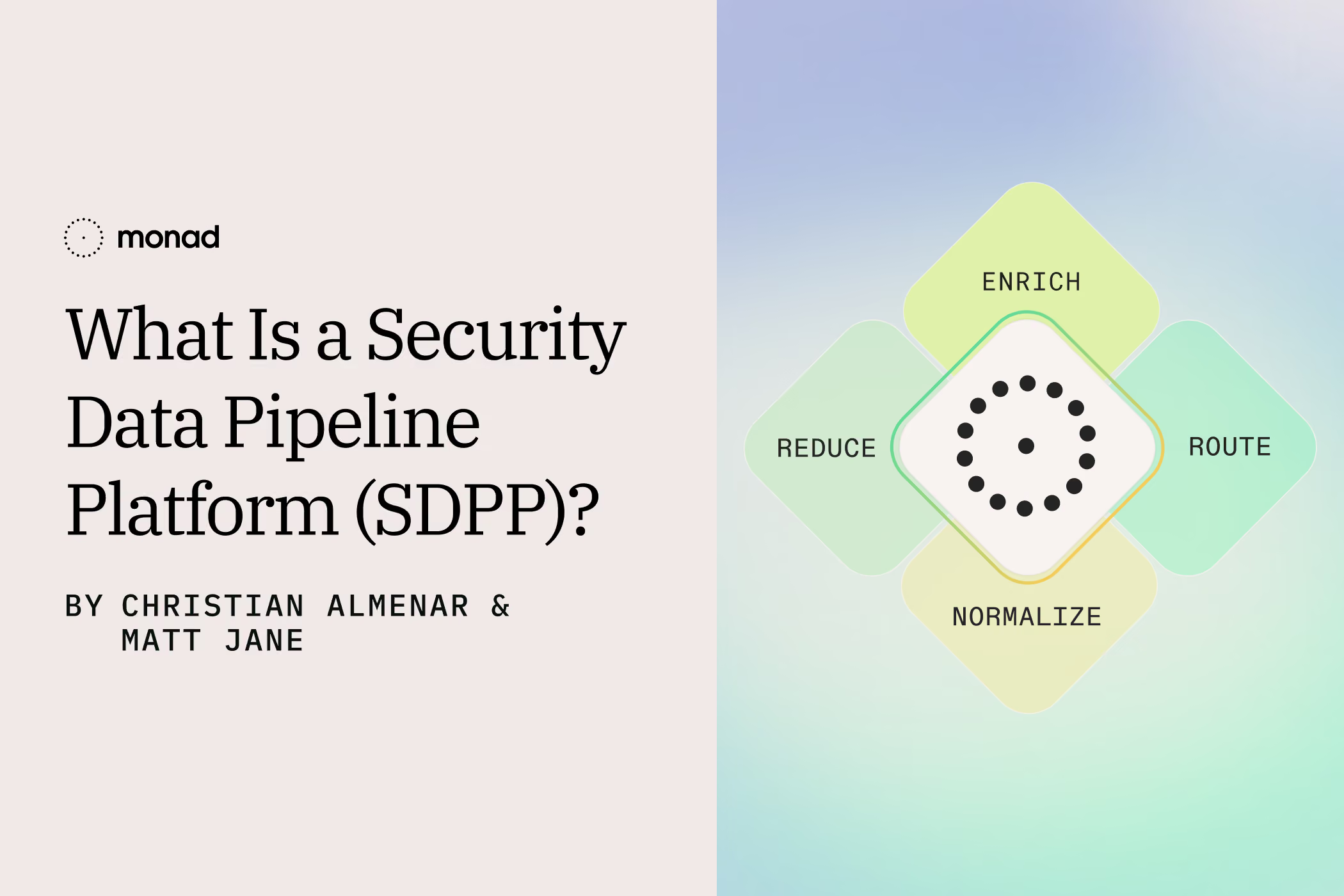
A security data pipeline platform sits between your data sources and your downstream systems. It owns the ETL layer that security teams have historically been forced to build, maintain, or overpay for. The core capabilities break down into five areas.
.avif)
1. Ingestion
Collecting data from the full breadth of a security stack. This means pre-built connectors for SIEMs, EDR, cloud infrastructure, identity providers, SaaS applications, vulnerability scanners, and everything in between. The connector count matters, but reliability matters more. A connector that silently fails for three days because of an API change upstream is worse than not having the connector at all. Automatic failover and clear visibility into what's flowing (and what isn't) are non-negotiable.
2. Transformation
This is the broadest capability, and the one where security-specific domain knowledge matters most. It covers three related but distinct jobs: normalizing data into a consistent schema, filtering out what doesn't need to reach a given destination, and transforming events to reshape, redact, or restructure them for downstream consumption. Filtering and transforms are not the same thing. You can use a transform to filter, but you can't use a filter to transform. In a well-architected pipeline, they're separate operations, often running at different stages.
Normalization means converting logs from dozens or hundreds of sources so that detection rules, correlation logic, and analytics queries work across the entire dataset. OCSF is the standard gaining the most traction here, though implementation depth varies. A general-purpose ETL tool might map fields; a security data pipeline platform understands what a principal is, what an authentication event looks like across five different identity providers, and why the difference between a failed login and a locked account matters for detection.
Filtering is about deciding what data reaches which destination. This is where the cost reduction case is most direct: if 50 percent or more of your SIEM ingest is informational noise that no detection rule references and no analyst queries, you're paying double what you need to. Examples: dropping informational Okta event types that don't contribute to detection, suppressing duplicate alerts from overlapping tools, or excluding routine DNS query logs from your SIEM while still routing them to cold storage. A single filtered source (Okta, for example) can go from $1,927/month to $950/month in SIEM costs just by stripping out the noise.
Transforms reshape the data itself. Examples: redacting PII fields before events leave the pipeline, renaming or restructuring fields to match a destination's expected schema, or converting timestamps to a consistent format across sources. Transforms are what let you send the same event to two different destinations in two different shapes, one optimized for real-time alerting and one for long-term analytics, without duplicating your ingestion.
3. Real-time Enrichment
Adding context to events before they hit downstream systems. Threat intel feeds, GeoIP lookups, asset inventory correlation, identity resolution, CISA KEV status for vulnerability findings. Enrichment at the pipeline layer is what lets a detection rule trigger on "authentication from a TOR exit node by a user with no prior travel history" rather than just "failed login from IP X." The difference between those two alerts is the difference between signal and noise. Upstream enrichment can reduce false positives by 70 to 80 percent, which is the single highest-leverage improvement most security operations teams can make.
4. Routing
Sending the right data to the right destinations based on configurable rules. High-fidelity authentication events go to the SIEM for real-time alerting. Full-resolution logs go to S3 or a data lake for compliance retention and historical investigation. Vulnerability findings route to the platform that handles remediation workflows. Routing is what makes a security data pipeline a pipeline rather than a point-to-point integration. It decouples your data sources from your analytics tools, which is what breaks vendor lock-in and makes it possible to swap or add a SIEM without re-plumbing every source.
5. Pipeline observability and alerting
This is the capability that neither the SIEM-native model nor the DIY approach gives you, and it's the one that matters most at 2am.
When your SIEM handles ingestion natively, you have limited visibility into what's actually arriving versus what should be arriving. If a source goes quiet, you might not notice until an incident investigation turns up a gap. When you build your own pipelines, monitoring is whatever your team had time to bolt on, which usually means basic health checks and not much else.
A security data pipeline platform should give you real-time observability into every pipeline: ingress and egress volumes, latency, error rates, and delivery confirmation. But the more important capability is intelligent alerting. That means detecting when a source that normally sends 50,000 events per hour drops to zero. It means catching schema drift, when a vendor ships an API change that silently breaks your normalization or your detection rules downstream. It means flagging volume anomalies that could indicate a misconfiguration, a source outage, or a logging gap that's creating a blind spot in your detection coverage.
For security teams, pipeline observability isn't an operational nice-to-have. A silent pipeline failure is a detection failure. The difference between catching a broken connector in five minutes versus five days is the difference between a monitoring gap and an incident you missed entirely.
Who inside a security org cares about this (and why)
Different teams feel the pain in different places. Understanding who benefits and how is important for anyone evaluating this category, whether they're the one building the business case or the one reviewing the budget request.
SOC analysts and incident responders care about enrichment and normalization. Their daily work is investigating alerts, and the quality of that work depends entirely on whether the data in front of them has context attached. Most SIEMs offer some form of enrichment - lookup tables, SOAR playbook steps that pull in context during triage, or threat intel feed integrations - but these capabilities vary significantly between platforms and tend to be limited in scope. Lookup tables need manual maintenance. SOAR playbooks add enrichment at investigation time, not at ingest, so the context isn't there when the alert first fires. And every SIEM implements enrichment differently, which means switching platforms means rebuilding all of it. When enrichment happens at the pipeline layer instead, it's consistent regardless of where the data lands. Analysts spend less time pivoting between tools to stitch together what happened. Response times drop. Burnout drops. The hours currently spent on manual enrichment, 20 to 60 minutes per alert, get compressed to near zero for the fields that the pipeline handles automatically.
Detection engineers and security engineers care about normalization and filtering. They write the rules that turn raw data into actionable alerts, and those rules break when schemas drift, field names change, or a new source uses a different format for the same event type. A consistent schema across sources means detection logic works everywhere instead of being rewritten per vendor. Filtering matters because detection coverage depends on understanding which data is available and which is noise. Engineers also care about pipeline reliability. An undetected gap in log delivery is a detection gap, and detection engineers are the ones who deal with the postmortem.
Security platform teams and security architects care about routing, cost, and observability. These are the people responsible for the overall data architecture: which tools get which data, how sources get onboarded, and how to keep SIEM spend from eating the entire security budget. A pipeline platform gives them a control plane for those decisions, and pipeline observability gives them confidence that the control plane is actually working. It's also the team most likely to be maintaining DIY pipelines today, and most motivated to stop. When you've been the person troubleshooting a broken Kafka consumer at midnight with no telemetry beyond "something stopped," real-time pipeline health monitoring isn't a feature request, it's the reason you evaluate the category in the first place. Platform teams also evaluate vendor lock-in risk. A pipeline that decouples sources from destinations is what makes it possible to migrate SIEMs, adopt a data lake strategy, or onboard a new analytics tool without starting from scratch.
CISOs and security leadership care about cost, risk, and operational efficiency. The pipeline conversation usually reaches them as a budget conversation: SIEM renewal is coming, ingest costs have grown 40 percent year-over-year, and the team is asking for headcount to maintain the DIY plumbing. The case for a security data pipeline platform is that it addresses all three at once, reducing ingest costs, improving detection quality through enrichment, and freeing engineering time for work that moves the security program forward. Forrester's recent work on security data cost management frames this tradeoff well: the question isn't whether to store security data, it's whether you're paying for storage and processing in the right places.
Why this category exists now
Three things converged to make security data pipelines a category rather than a niche.
SIEM economics hit a wall. Cloud migration produced more data. SIEM vendors moved to cloud-native architectures with ingest-based pricing. Data volumes grew faster than security budgets. At some point, the math stopped working for most organizations. Teams that were ingesting everything into a SIEM started asking hard questions about what was actually being used for detection versus what was sitting in an index burning money.
Tool sprawl compounded the integration problem. The average large enterprise runs 75+ security tools. Each one has its own API, its own log format, and its own schema. Maintaining integrations across that surface area is a full-time job for multiple engineers, and it's work that has to be redone every time a vendor ships a breaking API change or the team adopts a new tool.
AI raised the stakes on data quality. Every major SIEM vendor is building AI-powered analytics, automated triage, and copilot features. These tools are only as good as the data underneath them. If your SIEM is full of unnormalized, unenriched, noisy data, the AI layer inherits every one of those problems. Cleaning data upstream, before it reaches the SIEM, is a prerequisite for getting real value from AI-driven security operations.
The Gartner Peer Community has been tracking pipeline adoption patterns across enterprises, and the trajectory is clear: organizations are moving from ad-hoc, tool-specific integrations toward centralized pipeline management. The acquisitions tell the same story. When CrowdStrike, SentinelOne, and Palo Alto Networks are all acquiring pipeline companies, the category has crossed from "emerging" to "infrastructure."
How to evaluate a security data pipeline platform
If you're considering a platform for your team, here's a practical evaluation framework. These are the questions that separate products built for security from products adapted for it.
- Connector depth and reliability. How many sources and destinations does the platform support? More importantly, how does it handle API changes, rate limiting, and source or destination outages? What does pipeline health monitoring look like? Can you see, in real time, which sources are delivering data and which have gone silent?
- Normalization approach. Does the platform normalize to a recognized schema like OCSF? How deep does the normalization go - field mapping only, or full semantic normalization where the platform understands event types and categories? Can you extend or customize the schema for sources it doesn't cover natively?
- Enrichment breadth. What enrichment sources are available out of the box? Threat intel, GeoIP, asset context, identity resolution, CISA KEV? Can you bring your own enrichment sources? Does enrichment happen in-flight, or does it require a secondary processing step?
- Filtering granularity. Can you filter at the event-type level, the field level, or both? Can you preview the cost impact of a filter before applying it? Does the platform help you understand which event types are actually referenced by detection rules so you can make informed filtering decisions?
- Routing flexibility. Can you route to multiple destinations simultaneously with different transforms applied per destination? Does the platform support conditional routing, sending certain event types to the SIEM and others to a data lake based on rules you define?
- Deployment model. Can the platform deploy in your environment, whether that's cloud, on-prem, or hybrid? For security vendors embedding pipeline capabilities in their own products, does the platform offer SDKs and APIs for programmatic access?
- Vendor independence. Does adopting this platform create new lock-in, or does it reduce existing lock-in? Can you swap SIEMs without re-plumbing every source? Does the platform support open formats and schemas?
- Total cost of operation. Not just the platform's license cost, but the total picture: SIEM cost reduction from filtering, engineering time recovered from eliminating DIY maintenance, faster onboarding of new sources, and reduced manual enrichment per alert. The right comparison isn't "pipeline platform cost vs. zero," it's "pipeline platform cost vs. the current cost of doing this work poorly."
Where the category is heading
The SDPP market is consolidating, with the major security platform vendors acquiring pipeline companies and integrating those capabilities into their broader stacks. That creates a strategic question for security teams: do you adopt a pipeline that's embedded in your SIEM vendor's platform (which may re-create lock-in), or do you choose an independent pipeline that sits between all your tools and maintains vendor neutrality?
There's also a capability expansion happening. Some pipeline platforms are starting to take on adjacent functions: in-stream detection, federated search across destinations, built-in data lake storage, AI-powered pipeline optimization. The logic is intuitive. The platform that owns how data moves through a security program has a natural path to owning more of the operational layer around it.
We push back on that logic. That kind of scope creep is exactly the dynamic that made the SIEM-as-pipeline model problematic in the first place. When your pipeline vendor also wants to be your detection engine, your search layer, and your storage tier, the incentive alignment shifts. The vendor's interest in expanding their footprint starts competing with your interest in keeping your architecture modular and your options open. The whole point of a security data pipeline is that it sits between your tools and stays independent of them. The moment it starts trying to replace them, it becomes another platform you're locked into rather than a layer that prevents lock-in.
Our view is that the pipeline should do the pipeline job exceptionally well: ingest, transform, enrich, filter, route, and give you full observability into all of it. The value of independence is that your pipeline doesn't care which SIEM you choose, which data lake you adopt, or which analytics tool you evaluate next quarter. That neutrality is a force multiplier, not a limitation.
For security teams evaluating the category today, the important thing is to start with the core: reliable ingestion, real normalization, upstream enrichment, smart filtering, and flexible routing. Those five capabilities are what turn a security data pipeline from a cost optimization play into genuine infrastructure, the layer that determines whether your detection works, your analysts have context, and your SIEM budget stays sane.
Christian Almenar is the CEO and co-founder of Monad, a security-native data pipeline platform. Matt Jane is the CTO and Chief Architect at Monad.
Related content
Valerie Worman
|
September 23, 2026
.avif)